Tuesday, September 15, 2015

Pencil Talk

In my classes I tend to take a few lessons to focus on writing.  Just as young children learn to speak fluently, they also need to learn how to write fluently. Writing in English is quite rewarding for the students as it is a visual representation of their language skill (Cameron, 2001 in Linse, 2005). It is therefore important for us as teachers to take our time in helping our students write as well as possible. 
In our classroom we employ the process-writing approach, which can be adapted to both Elementary and Middle school levels. This approach involves a step-by-step build up to the final written piece (Linse, 2005). We talk about what we will write by brainstorming and collecting ideas, and work towards our direct objectives .
 
 
Step 1: Pre-writing
Pre-writing or warm-up activities are essential for all students as they provide encouragement and build up the students’ confidence ahead of the main task (Linse, 2005). During pre-writing activities the students are able to share thoughts and ideas, as well as expand their vocabulary. For instance, a short conversation about the topic can be enough to collect thoughts and ideas. We can facilitate by asking simple questions related to the topic. One of my favorite pre-writing techniques is the use of mind-maps. Mind-maps are a good, creative foundation for writing since all thoughts and ideas are consolidated, and students can easily transfer those thoughts and ideas into their main writing piece. Mind-maps have proven to be effective at both Elementary and Middle school levels.

 
Step 2: Write
For the main writing process you can use different approaches based on your students’ language ability.
Controlled writing or guided activities help students practice the language, and build up their concentration and confidence in the target language (Linse, 2005). It is also a good way to ease low-level students into writing practice.
Guided writing practice can be in the form of a fill-in-the-blanks activity where the students are provided with a word bank to help them complete their writing piece. For ESL students it is also a good idea to include pictures in your word bank as many of the students are still learning to read and will therefore be able to build associations based on the pictures provided (Wright, 1989).
In a few of my information-gap-fill worksheets, I also included a simple checklist, with multiple-choice options. In this activity, students were provided with a range of options and they chose the appropriate word to fit their story. Once they had completed their checklist they filled in the gaps on a paragraph based on our topic.
 
Free writing covers a much wider range of activities, such as, poems, book reviews, letters, invitation cards, and short stories. These activities give the students an opportunity to creatively express their thoughts and ideas (Linse, 2005). However, writing freely can be difficulty for ESL students. For this reason I like to include a sample of what the students work should look like as it gives them a basic idea on the common goal that we set for the class. Our main aim is to get students to write complete sentences using proper grammar and punctuation. For the lower level writing practice we include a few articles, and subject words, just to facilitate their writing practice. For higher level students we use key questions as a reference. With this approach, we have seen a great improvement in all our students, at both levels.
Once students have completed their first draft, you can work with him/her to revise and edit their written piece. This will give you the opportunity to correct grammatical errors and ensure that the student's ideas have a logical flow. At my school, we like to get our students involved in the editing process. This method has helped our students improve their writing while helping their classmates.

Step 3: Publishing
The final piece should be re-written in a presentable form so that it can later be displayed or shared. We provide special paper for our students to write their final piece because we always display their work around our classroom, it also creates a sense of pride for the students.
 
 
Dos and Don’ts on writing
Dos
· Concentrate on content. It is important for us to help our students produce work with substance.
· Spend time on pre-writing activities. Talking and planning ahead of writing is just as important as the final product. Get the students into the habit of planning and organizing their thoughts and ideas first, this solid foundation will be beneficial to their language progression.
· Walk around while students are writing and offer suggestions to help them improve their work.

Don'ts
· It is not good to announce the subject you intend on teaching out of the blue. You want to ease the students into the topic. This is where the pre-writing activities play a major role. My co-teacher and I tend to get a little animated when we start a new topic. We do a little role-play, which includes key phrases and vocabulary from the new topic. We then ask the students to describe what they just heard and then proceed to present the lesson, and finally introduce the topic we wish for them to write about.
· Avoid setting work that is beyond your students’ language capability. I suggest spending some time observing your students, make notes on their strengths and weaknesses; this will help you when you planning your lessons and ultimately ensure that you meet the needs of all your students.
 
The tips and ideas presents above can be adapted for any grade level. I encourage you to observe your students and assess their abilities before planning your lessons. Teaching English as a Second Language requires patience and flexibility, in order for your lessons to be effective.
 
 
Reference
Linse. C. T (2005) Practical English Language Teaching: Young Learners, McGraw-Hill: New York
Scott. W. A & Ytreberg. L. H (1990) Teaching English to Children, Longman: New York
 
Slattery. M & Willis. J (2001) English for Primary Teachers - A handbook of activities and classroom language, Oxford University Press: UK
 
Wright. A (1989) Pictures for Language Learning Cambridge University Press: Glasgow 

Friday, February 21, 2014

Toilet Paper Crafts

Since I started teaching in Korea I have unleashed a creative side in me I never knew I had.  I've become creative with thinking up fun games and lessons but best of all I have become a bit of a pro at recycling toilet paper rolls.  My first tp roll inspired craft were these cute little owls.

Toilet paper roll owls

We used:

  • Toilet paper rolls
  • Origami paper (150 x 150 mm)
  • Plain white paper
  • Glue
  • Markers
  • Scissors
Construction:  

  • We glued a sheet or origami paper around the toilet paper roll and tucked in the excess paper.
  • Next we pressed in the top of the roll (like the picture suggests) and ended up with two pointy ears.
  • On a separate sheet of paper we drew two tear drops, these served as wings for our owls.  We glued the round ends to the side of our rolls with the pointy bits sticking out.  You and your students can decided on the direction of the wings.
  • Using the white paper, we drew circles for eyes, cut them out and glued it to our birds.
  • Finally, we cut out a little triangle to make a nose and stuck it in between the eyes.
 I allowed the students to get creative and decorate their owls however they wanted to. We had such a blast making them that it we decided to do more crafts using toilet paper rolls which I will share in another post.


Sunday, December 1, 2013

Mind-Mapping Me

This year,  I was relocated to an Elementary School due to financial reasons within the education office.  I previously taught at a Middle School for four years so this change mean't having to learn how to connect with younger ESL learners.

It's always a good idea to use the first lesson at any new school as an introductory lesson.  This will give the students the opportunity to learn about you.  You can talk about your likes, dislikes as well as where you come from.  I put together a detailed PowerPoint presentation with pictures of hobbies, interests and my country to educate the kids about "Miss Candy"  (that's my name at school).  To make the lesson a bit more interactive, I asked the students to guess what each picture represented.  This engaged the students and held their attention for the entire lesson.

After School Class
Part of my responsibilities at the new school is to conduct an after school class.  I have complete control over this class which means that I get to select the lesson topic and chose the direction in which I want the lesson to head in.  I meet with the students three times a week so I have to have a different lesson prepared for each class.  The after school classes lasts 50 minutes (10 minutes longer than regular classes) which means that my content needs to be super fun or I will lose the kids at minute one. I currently have 5 students in my after school class which is perfect for giving individual attention to each student.
Map about me

For my introductory lesson with my after school class I got the students to create mind maps about
themselves.  I supplied the students with poster paper and a template of an apple.  We wrote our names in the centre of the apple and used that as the core of our maps.  I got the students to write little sentences about different things they like, their hobbies, family and friends.  The kids also  got a little creative and drew little pictures to illustrate their points.

The objective of the lesson was to learn about each each other but it also gave the students an opportunity to practice writing in the target language.  This activity will also be great for the first day of class at the start of a new school year.


Wednesday, August 21, 2013

Reading Power Tower

Over the summer vacation we are required to host "summer camps".  It's a real camp because we're not outdoors, there's not tent or camp fire, no toasted marshmallows...I could go on, but, I think you get the point. They are just vacation classes!   Summer in Korea is hot and humid.   It's not fun being outside let alone being in the classroom.  I spent weeks preparing for these vacation classes because I wanted the activities to be exciting but not too "strenuous" so that the kids would not become more hot and bothered.  I trolled the internet for ideas and came across an activity called the math power tower on Pinterest.  Now, I'm no mathematician so I decided to do a spin off and focus on reading.

In the original post the brilliant teacher got her students to provide the solution to various math problems which were printed on paper cups. Once they had given the correct answer they would stack the cups in order to build a tower.

For my class I used the same idea but in place of math problems I pasted tongue twisters to the paper cups.  I stored the cups in empty Pringles cans so when each student came to the front he had to pop a cup out, read the tongue twister and contribute to the construction of the tower. The Pringles cans were covered with a sign that said "reading power tower". We used about 50 cups for this activity and were able to build three towers.

Some tongue twisters were trickier than others which made for some good laughs but the students had a blast.
Reading power towers


Novel study

Reading is not always fun when you're young but our parents and teachers try their best to encourage to read as much as possible.  I remember my dad nagging me to read all the time so that I could expand my vocabulary and be able to construct good sentences.  I was excited when my co-workers decided to start a reading class at our school, I was more excited that they gave me complete control.  Last year I taught the students a few short stories and fables which were well received. This year we decided to teach the students short novels.  The books that we chose were "Charlie and the Chocolate factory" for our the first graders (7th grade) and "Charlotte's Web" for the second and third graders (8th & 9th grade).  My excitement soon turned into stress when it dawned on me that I had roughly 15 weeks to teach these books to second language students.  But, I accepted the challenged and spent all my free time researching effective strategies for teaching. I coupled the information I found with my six steps for lesson planing and came up with different lessons each week.  I did experience a few hiccups every now and then but I had overall success.

So here's what I did...


Lead-in and elicitation
The lead-in activity is an opportunity for the students to identify the topic using previous knowledge. The pictures, videos or flashcards used will help students create stronger associations. Next, I will ask students to predict and guess what they think the story is about. In a controlled manner I will get them to shout out answers, this will get them excited to read and find out if their predictions were correct.
 For example, during my introductory lesson on Charlie and the Charlie factory I showed the class the trailer from the movie which was actually a lazy move on my part but it seemed to have produced the results I was hoping for. Whereas, for Charlotte's Web I took an entirely different approach.  Since this book was targeted at higher level students I decided to teach an entire lesson on animals...So in effect my lead-in lasted almost 30 minutes; however, seeing as this was my introductory lesson it wasn't altogether bad. 

Presentation
My class is 45 minutes so I don't have enough time to go through an entire chapter in class.  I also wanted to give the students the opportunity to read independently so I needed to condense my text.  For each lesson I made a summary of the focus chapter which we read together.  Students were instructed to just skim through the short synopsis of the story to get a general idea and not to look for specific details. Afterwards we had  a brief discussion on what they read before moving onto the next task.  At this point of the lesson it's a good idea to discuss new vocabulary and key phrases relevant to the overall understanding of the text.

Controlled practice
For this task the students were giving an activity to test their understanding of the text. each class had a different activity so that the kids were constantly engaged and didn't get too bored by the same book.For example, during our lesson before mid-terms I put the students into groups and they were required to create a mind-map in which they had to fill in specific details such as location, time, people involved etc. I instructed each group to read the synopsis carefully at least 2 times and work as a team to fill in the information.  This task required students to read for detailed information.  During this activity I walked to each group and offered assistance. 

Freer practice
For the final task, students worked individually and answered comprehension questions.  The questions were related to the text however did not contain the exact words; therefore, students were required to exercise their thinking. This task will work as a strategy of interpretation because students will have to look for clues within the question and draw conclusions. 

Feedback
After students have read the summary and filled in relevant information into their charts I did a quick review to check their understanding and to explain certain parts of the text that may have caused confusion. We looked at each category specified in the chart and had a brief discussion on each. We also checked the answers to the final task and discussed the students initial predictions on the story. 

Follow-up or homework
As mentioned above, due to time restrictions we were unable to read an entire chapter in class, hence the use of short summaries. As a follow-up activity and for homework students were required to read the full chapter by themselves and to jot down words or phrases they found difficult.  During the start of our next lesson we reviewed the past chapter and covered new vocabulary. 

Thursday, August 15, 2013

A word or two

My summer vacation has sadly come to an end.  Time always flies when you're relaxing but seems to stand still once you step out the door to go to work.  With the end of our summer vacation comes the stress of having to plan new lessons for the new semester.  My friend, Sandra and I were bouncing ideas off each other for cool ice-breakers and class fillers and she came up with the most brilliant idea.  It's a fusion of scrabble and jenga.  I think this game actually exists but our version is a little different.

For our version of the game I printed out scrabble tiles and glues them to the jenga blocks.  It's a lot of work but seeing the excitement in the kids eyes when you say "we're playing jenga" makes it all worth it.
An afternoon of cutting and pasting

High level of concentration
Sample word
I played this game during my summer classes.  I split the class into teams and got a member from each team to come up and make a three letter word by strategically moving jenga blocks.  Teams were then awarded points which are calculated by adding the the points written on the scrabble tiles.  I didn't tell my students how the scoring worked but when they figured it out, it challenged them to make better words.  We had a lot of fun with it, the wobbly desk in my classroom added to the intensity.  

I hope you and your students can have as much fun.
Happy teaching!


Friday, June 28, 2013

Lesson Planning 101

Every week I have the task of coming up with an exciting lesson.  I have found that understanding the needs of my students ahead of mine are the most important aspect to take into consideration when planning any lesson. As teachers it is vital for us to identify the type of learners we have (i.e. visual, auditory, kinesthetic) before planning a lesson as it makes work a little easier.  I'm currently teaching at an all boys middle school and I've found that majority of my students are visual learners; however, I try to fit in activities that also appeal to my auditory and kinesthetic (tactical) learners so that they don't fall behind.

The next step is to pick a topic that will appeal to everyone in class (teacher included).  For the purpose of this post I have chosen "Animals".  It's one my favourite topics as it can be taught to any grade in numerous ways.

Now that I have a topic and I know what type of learners I have I will start planning each step of the lesson taking time into consideration.  My classes in Korea are 45 minutes long so I will need to have enough prepared to fill that time without becoming repetitive or redundant.

OK! Let the planning begin!

Step One:  Lead-in ( 3minutes)
This is where you will introduce your topic to the class.  Audio visual aids such as a music video is an excellent lead-in tool.  The lead-in should be 5 minutes or less as it is just a warm-up. For example: **Old McDonald had a farm**, could be a  fun lead-in for a lesson on animals.
After listening to the song/watching the video you can ask the students to guess the topic, it gives them a little thrill when they make the correct guess.


Step Two: Elicitation (5 minutes)
Here, you want to find out how much your students know about the topic.  A good way to elicit information from the students is show them a prop such as flashcards or a PowerPoint presentation.  Each image or prop will get the students talking. For example in a lesson on animals you will show the students images of different animals to check if they can identify the animal.  You can take it a step further with higher level students and check if the kids know the names of the offspring and to make things more exciting, you can talk about the sounds animals make.

NB:  Using funny looking images creates a lighter atmosphere in the classroom as it draws the student in and builds greater engagement.

 Step Three:  Presentation (7 minutes)
In this step you will be presenting the main topic.  So if you chose the theme of animals you have a sub-topic such as animal homes.  During your presentation you will talk about this.  PowerPoints; Flashcards or Charts are great for presentations.


Step Four:  Controlled Practice (10 minutes)
At this point you would want the kids to put into practice everything they have studied.  The best way to test their knowledge on the day's lesson is through a work sheet.  Another great tool is doing a role-play.  Most often your topic will dictate the type of practice most suited for the lesson.

Step Five: Freer Practice (15 minutes)
Once again you will be testing the students knowledge on the lesson just taught however with this step you can be more flexible.  Games are great for this as it creates a "freer" learning environment.  It's both entertaining and educational. With this set you can do more that one activity depending on your time.

Step Six: Review   (5 minutes)
Towards the end of the lesson it's good to do a quick review to tie up the lesson. Review could be a short worksheet like a word search which they can complete in class or something longer if you wish to give the students homework for the day.


Pictures courtesy of Google Images

Friday, June 21, 2013

Vocab Builder

I'm in the process of planning fun activities for my summer camp.  Like every lesson that I plan, I have to take into consideration my "target audience".  The kids who usually sign up for my vacation classes want to be entertained and not taught.  These classes are four hours a day for 2 weeks but they can feel like an eternity if you have insufficient material prepared, unenthusiastic students or worse, BORING lessons.  With fours years of camps under my belt I have found what works and what doesn't.

My students are huge fan of games and movies. They cringe every time I pull out a worksheet and pass out as soon as I start talking for more than 10 minutes.  Taking those hurdles into consideration I have planned some exciting tutorials and activities for this summer.

Sample Board
While preparing and researching ideas for new activities I came across this gem ===>
                   A boggle bulletin board
You will paste the letters on your blackboard (or a wall of your choice) so that everyone in class has a good view of it.  Give each student his/her own answer sheet and get the kids to make up words.
It's a wonderful opportunity for the students to build their vocabulary and practice thinking independently.  To make things more exciting you could set a time limit and dish out candy to whoever gets the most words in that time.


It's exciting when the kids get all competitive and you can steal a few moments of silence whilst they are busy writing out their words.


Source: www.technologyrocksseriously.com
Images courtesy of Google images

Tuesday, June 4, 2013

Hiatus

Wow!  It seems like ages since I've posted.  The guilt is slowly nibbling at me but before it consumes me I have decided to write a little apology to myself and whoever has visited my page with the hope of finding something resourceful.
 Mitchell Park Zoo, Durban
In Korea, native teachers are given the opportunity to renew their contracts.  The benefits of renewing allows you a two week vacation as well as a handsome bonus.  I used my bonus to book a flight to South Africa where I could spend some much needed time with my loved ones.  Fortunately for me, I was able to combine my winter break with my 'bonus' two weeks which gave me a wonderful month to regroup in the comfort of my family home.


Durban Harbour

The weeks leading up to my big return home were unpleasant as I caught a cold due to the serve winter weather that we experience here.  To make matters worse, I had to teach at our school's winter camp; that did not aid in the recovery process at all.  I kept joking that when I got to South Africa I would defrost under the African sun and will finally be rid of all the cold bugs.  Little did I know, these little bugs caught a piggy back ride with me home.

Flag Farm, Ballito
From the day I landed in SA till the day I left, I had experienced all sorts of aliments.  It wasn't the best of vacations; however, having my family around to take care of me was comforting.  On the few days that I was feeling a bit well, I was able to be a little touristy in my own backyard.  It was wonderful just being under African skies, listening; smelling; and tasting, all the things I grew up with.

Dubai_UAE
Before coming back to Korea, I had a stop-over in Dubai.  I was granted a tourist visa and free accommodation by my airline which afforded me the opportunity to tour the stunning Arab city.  And then, it was back to Korea!

I arrived in Busan the night before our new school year began so the first day at work was absolute torture.  

We are a few months into the new semester and I think I've finally adjusted to being back.  The work load for me this semester has been daunting, hence my failure to blog.  To add to that, I've been falling ill frequently which completely slays me.  I guess it's true when they say "old age is a pain!"

Friday, November 30, 2012

Boys!

I have the joy of teaching at a boys middle school.  I say joy because my students bring me a ton of happiness especially on those offish days when I feel like life is horrible and all I want to do is curl up in bed and sob like a 3 year old.  They are always full of life and their smiles melt my insides. When my boys see me outside school they run to greet me or will stop in the middle of the street to bow. However, there is also a dark side to them.

They are boys! So, naturally they are rough, dirty and noisy.  Like most teenagers, they are super competitive as well.  A simple game of bingo can become very violent, very quickly.  Don't ask me how! It just happens.
Sports Day '12 - The Chicken Fight
We have a 10 minute recess in between each class.  This gives the teachers a chance to make a quick dash to the toilet or grab a cup of coffee which means the students are left without supervision.  During this time the kids behave as though they have just been released from prison.  You will find them running up and down the hallway; hugging each other; throwing stuff at each other; and kicking around all sorts of little things they can find.  But, as the saying goes, "it's all fun and games till someone gets hurt".  One minute you will hear roars of laughter, the next you will find an army of boys rushing to the nurse with an injured boy.  Injuries usually range from a tiny scratch to nose bleeds, broken limbs and a number of other bloody wounds.
Over the past two weeks we have seen a few casualties come to the teachers office with the same injury.  It's like a growing epidemic or something but somehow 3 boys all sustained injuries around their left eye that required stitches.

Ji Woo's rendition of the Gangnam Style dance
Needless to say, the injuries do not stop these kids from running wild and from showing their affection toward each other through playful violence.  At times I'm torn between laughing at them and feeling sympathy.  There's constant entertainment at my school and I'm never left with a dull moment.

Monday, November 19, 2012

Teaching Evaluation

Koreans take education very seriously.  Parents are more involved and teachers have sleepless nights thinking up new ways to improve their lessons to be effective in their classrooms. To add to their stress all teachers, both Korean and guest English teachers, are required to open their classrooms to parents, fellow members of faculty and teachers from neighbouring schools.  

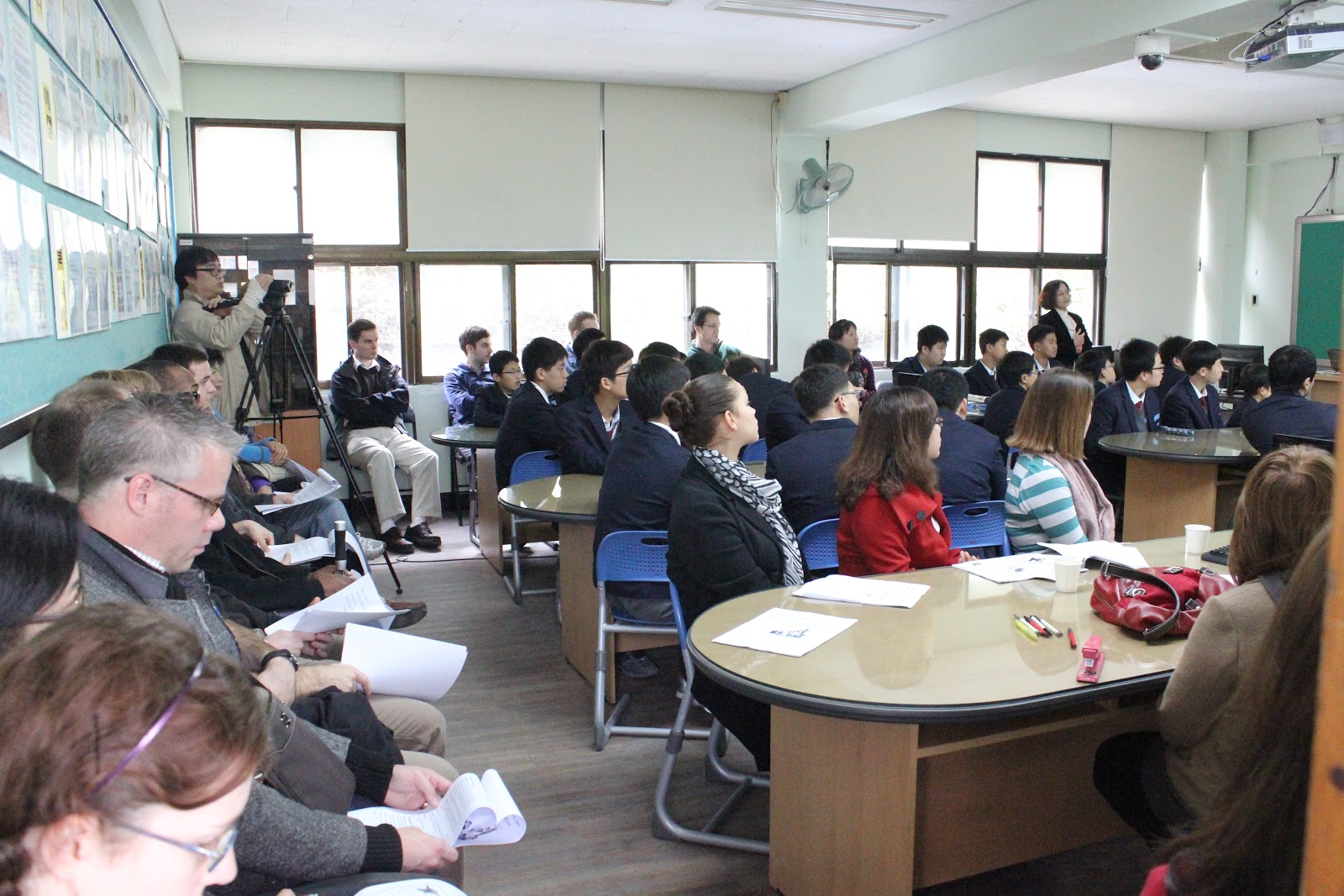
I was required to host several open classes since I started teaching. Having the parents sit in your class is not so stressful as most of them don't know much English and won't understand what's going on.  They are just thrilled at hearing their children say a few words in a foreign language.  My stress built up when the principal, vice principal, all my co-teachers and a few senior members of faculty came into my class, not just to watch! They came to evaluate my teaching skills. 

Last year (2011) was no different, I spent weeks preparing my lesson to impress their socks off.  Finally, the big day arrived, my students were a dream to teach.  They were well behaved, answered my questions to point, they actively participated in the activities and completed all written tasks. After the class I received a heap of compliments and my stress was over.  But, that was short lived. Little did I know that I was secretly being entered into a competition with other native teachers within my district.  A few months after my open class I was informed that I ranked among the top ten teachers in our teaching district which meant that I would have to host another open class.  I did not know if I was happy or sad with the news; but, I took on the challenge and began working on my lesson plan for my  follow up class.  Again, my school evaluated me but, this time my class was recorded and a copy of the video was sent to the education office for evaluation.  Just before we went on our summer break I was informed that I had passed the second round of the competition and now ranked in the top 5.  "Yay me!" I thought. However, this meant that I had to have ANOTHER open class, only difference this time was that there would be guest English teachers from neighbouring schools observing my class.  Talk about pressure!

Many MANY visitors
I spent the entire summer break perfecting my lesson.  I stressed everyday for 2 months until D-Day.  My co-teacher sent out invites to all schools in our district thinking that only a few teachers would actually show up.  To my horror, I had over 20 visitors on top of the teachers from my school.  This class was also recorded for the education office to evaluate.  During the class I focused on my students and blocked out the crowd of judging eyes. 

In my eyes, the class was a success and my co-teachers took me out for a huge dinner to celebrate.  Before the semester ended we received a call from the education office informing my school that I was crowned "Super Teacher" in our district.  I received a certificate of excellence from the Busan Metropolitan Office of Education as well as a cash incentive.  It has certainly been the highlight of my time in Korea.  All my stress and hours of planning definitely paid off.

Below is a link to the video from my open class.  My friend, Tom, was kind enough to upload it to his YouTube channel so that we can demonstrate what teaching ESL in Korea is like.  


**Video Courtesy of: http://www.youtube.com/user/SeoulTee **


Wednesday, October 31, 2012

Happy Halloween

The 31st of October is commonly referred to as the scariest day of the year.  Growing up in South Africa I never celebrated Halloween.  Somehow the spooky holiday never made it to our country.  It never quite made it to Korea either; however, with the gradual "westernisation" of Korea certain "American" traditions have crept in, namely, Halloween.


Being at a middle school it's safe to assume that my students have already had their introduction to Halloween.  I was proven right in that assumption when I first began teaching because my boys somehow knew a lot more than me about this creepy day.  Therefore, this Halloween I decided to take a different approach.  I quickly ran through the reasoning behind Halloween and what people do in celebration of this day followed by a music video.  


I played "Backstreet's Back" by the Backstreet Boys ~ They are stranded at a haunted house and turn into various monsters... Very Halloween! :)


Since my class focuses predominately on reading, I opted to read a Halloween themed story.  We read through the story once and I explained each line as we went along, I also picked out difficult vocabulary and explained it.   This particular story has an open ending which allows for the students to get creative and write their own ending to the story.  I gave them a few examples of how the story could end and explained that they were at liberty to decide if the story had a happy, sad or horrific ending.

My students' intended to write horrific endings but with their choice of words and over dramatisation I found them to be quite hilarious.

For a more controlled practice I prepared a set of comprehension questions which they were required to answer before they left.

To end the class on a high I hid candy under a few chairs and used the last 2 minutes of the lesson for the "great candy search". It saved me from having to buy a ton of Halloween candy and scored me some points with the kids. :)


Source: http://bogglesworldesl.com/halloween_worksheets.htm

Thursday, October 18, 2012

Inspiration

Over the past three years that I have been teaching in Korea, I have had many laughs.  My students' never cease to assume me with the quirky little things they say and do.  But, there are times when they say the most mind-blowing stuff which leaves me speechless.

This week, I have been testing the students' speaking ability. The test is structured in the form of an interview so I get to speak one-on-one with my boys. This test has given me a little more insight into some of my students and I feel more connected to them.

I selected three questions which have more of a personal feel.  I went through each question in class a few weeks earlier in preparation for the test and gave the students some skeleton points to work with when answering the questions.  A few students asked me to check their grammar and sentence construction because they were really determined to get a perfect score on this test.  It really pleased me to see the great initiative that was put in by most of my boys.

And so the interviews began... Some better than others. Some were excruciatingly painful for me because of the blank looks on their faces.  I had a few laughs along the way but what really caught my attention was the heart warming answers that some of my students gave.

Here are a few of those precious conversations with my second grade (8th grade) students.

Question:  Travel can be a great experience. Which country would you like to visit and why?
Answer: I would like to visit different countries in Africa because they are poor and I want to help them.
Question: How would you help them?
Answer: I will get money from my father and give to them.


Question:  Which country would you like to visit?
Answer: North Korea!
Question: Why?
Answer: I want to take food and money to them.


Question: What is your dream job?

Min Chul: I would like to be a dentist because there are many poor people with no teeth and I want to help them.

Oh Won:  I want to be a diplomat and work to bring peace in the world.


Jae Young: I want to be a teacher like you and help students study hard.

Chan Huk: I would like to be a doctor because my sister is sick and she is always kind to me but I'm not so  kind so I want to be her magician and make her better.
**This student went on to tell me what was wrong with his sister and how sad his family is.  I was brought to tears.**


The next one is slightly funny but at the same time it's really sweet.

Question: Tell me about your best friend.
Answer: My friend is very cute. He looks like a flower and he has many girlfriends.
Question: Do you also have a girlfriend?
Answer: No!
Question: Are you sad that your friend has many girlfriends and you don't?
Answer: No, I'm not sad because he is my friend and he is happy so I'm happy with him.

It's an absolute blessing to be teaching these boys.  They can be a handful at times but they bring so much joy on a daily basis.  I love them to bits!


Friday, September 7, 2012

Fable Time

Since I've been in Korea I've always taught relate-able topics to the students so that it encourages them to speak in the target language.  In my first year I dug deep into Google to find ideas and topics that I could adapt into my classroom. In my second year I began using the prescribed textbook which made life slightly easier; however, the topics in the book were dull and the language sounded very robotic so I added a bit of my own spice to those topics and created lessons which I knew my students would enjoy.  At the start of this year I was told that we needed to grade the students for reading and my co-teacher asked me for suggestions for books.  I gave a few suggestions "Charlie and Chocolate Factory" was thrown into the mix and to my surprise that was the book the English department decided to go with.  A little into the first semester I was asked to stop teaching from the textbook and I was handed this golden opportunity to teach my students literature.  It was the start of a lot of work but the end of silly-textbook-robot-English. I grabbed the challenge and ran with it.  I surprised myself as well as my co-teachers with my careful adaptation of the text into low-intermediate ESL teaching material.

Riding on the success of the first semester, I was asked to find new literature to teach this semester.  I decided to go with fables because they are short and the language is simple enough for the students to follow.
Coming up with the idea to teach Fables was the easy part; planning the lesson was a bit of a struggle but nonetheless I got it done with the help of a few useful online tips.

The figured that the first step to teaching fable is picking a "good" version of the story.  There are a number of variations to the Aesop's original work so it's important to pick a version with simple vocabulary which are suited to second language learners.

Lead in: I began by reading through the story once.  For this you can get the students to read a small paragraph to aid in their reading practice.

Elicitation: After the first reading I got them to give their understanding of the fable.  If the language is simple they will be able to pick it up immediately.  Next, I went through each line and picked out difficult or tricky words and we discussed them, the students also wrote down the meanings in the margin.

Controlled practice: For this part I like to use an interactive activity like running dictation or a story map where they are required to document the timeline of the story.  The students get to work in groups or pairs depending on the size of the class and help each other understand the story better.  They are likely to use their mother tongue during this activity but their minds will be working over time as they will be translating their thoughts into English.

Freer practice: Our school dedicates the last 5 minutes of every class for a short time of review.  During this time I like to give the students a short worksheet with a few comprehension questions based on the story done for the day.  However, we sometimes run out of time and in this instance the students complete the worksheet as homework and we have a quick review at the start of the next lesson.

I've implemented this lesson plan in my classroom for the past month and a half and everyday I find new ways of tweaking it a little so that it doesn't become boring for both the students and myself.  Hopefully, by the end of this semester I would've mastered the art of teaching fables.  Till then, Happy Teaching.


Source: Fable Time: Using and Writing Fables in the ESL Classroom

Monday, August 20, 2012

...And we're back!

Hello Second Semester!

Returning to school after the vacation is the worst! I sometimes feel as though I'm more depressed about the start of the semester than my students but then I show up to class and see their cute little faces and that sadness disappears.

Like me, the students don't want to be at school so to make the day less painful for all of us I like to kick off the first week with a few ice-breakers and games.  Often times the students get really sucked into the first game that we play so we end up just playing that for the rest of the class.  My co-teachers also get into the spirit of things and join in which is always encouraging.

Today was rather easy for me as I only had one class but I'm certain that the rest of the week will follow suit.  Here's hoping for a great semester and lots of smiles along the way!

Friday, July 20, 2012

Happy Summer!


Today marks the end of the first semester. Like most teachers I am ecstatic.  Don't get me wrong, I love my job but to be effective in the classroom we as teachers deserve a lot of rest and relaxation.  Being an ESL teacher in Korea limits this time to 8 days during the summer vacation (as per our contract) and we are required to teach a summer camp for 2 weeks prior to our vacation.  But, the upside of the camp is that you have complete control of how you use your time.

 Summer in Korea is HOT and HUMID and the last thing the students want is to sit and listen to me lecture on. So, keeping that in mind I have planned a series of interactive games which doesn't require too much prep work and will allow for time to pass swiftly.  


One of my favourite games is "Stop the Bus"  It's excellent to review vocabulary or parts of speech.  


How to play:   Write 5 categories on the board, for example: 


1. Animals
2. Sports/games
3. People
4. Places
5. Food

Then choose a letter. Get them to write one word for each category that starts with the letter. I also place a time limit which makes things a little more competitive but the students have a lot of fun.

You can put the students into teams if you're working with a large group.  

Variation:  Instead of the categories mentioned above you can get the students to write down a noun, verb and adjective beginning with a certain alphabet.  

The first team to fill in all the categories shouts "STOP THE BUS!" and all other teams must stop writing. Points are awarded for every correct answer. 

The students get really into this game and even when I say "game over" they beg to continue.


NB: Take a look at my post on games for more ideas. But, above everything else, have a SUPERB SUMMER!!!


Tuesday, July 10, 2012

Laugh out Loud


I love to laugh, even in a difficult or awkward situation I will find a reason to crack a joke and laugh.  Being in Korea has certainly contributed to my need to laugh out loud all the time.  My students have a very low grasp of the English language but they try really hard and that brings me a lot of joy as fulfilment. Through their valiant efforts in trying to study English they manage to make me laugh.

I am required to conduct interviews with the students every year and grade them on their speaking ability.  It's usually difficult to keep a straight face because their answers are out of this world funny.

Here are some highlights from my classroom.

Me: What job would you never do and why?
Student: I don't want to do any job that uses my body because I don't want to get tired.
Me: What job would you like to do?
Student: A job that only uses my mind.

Question: What do you want to be when you grow up?
Answer:  I want to be a mathematician because I want to have smart brain. My favorite subject is math. Especially I love numbers from zero to nine, numbers can make lots of various problems. So in the future I want to be a mathematician like Euclid.


Task: Write a travel diary about a trip you took with your family or school.

My Travel Diary


Hello, I'm Kim-Dohyun. Now, I'm going Igidae with my family.  The place is very dark at night and a lot's of warm. But it is very funny.  Next time, I'll come again.

My Travel Diary


When I went to Seoul I was very excited but I felt dissopointed because we were going Everland again!  At first night I slept with 'Lee Hyun' I thought he didn't take a shower because he smelled very dirty but I slept because I was tired.
This trip was tied but very exciting! but I didn't want to go Everland again.


The next conversation took place during the 3rd lesson of the day.  It was a Tuesday morning around 11:15 am. So my students shouts from his seat, "Teacher, what time is it?"
I reply, It's 11:15. Why? Do have an appointment?" 
He responds, "No, I'm hungry! My stomach alarm is ringing."


There is never a dull moment in my class.  I could publish a small book if I wrote down every little thing my students say or do.  I love them to bits!^^


Monday, July 9, 2012

Vacation classes

One of the first things I learnt about Korea was that they are passionate about education.  Their passion is so great that you will find students returning from a learning institute at midnight, and getting up early over the weekend to go to school.  As a guest English teacher we are expected to go with the flow and teach during the vacation. As predicted the students don't want to be there and us teachers would much rather be spending our summer at the beach or travelling to some inexpensive yet exotic location.  Thus, to make the 2 longs weeks move as fast as possible I turn my classroom into a cool vacation hang out.  

Day one usually begins with a short introduction lesson.  I also assign nicknames to the students (it makes it easier for me to remember).  To keep the atmosphere light I play a game of pictionary or charades and I dish out candy.  Fortunately we only have to be at school for 3 hours so by the end of it the students are "hypnotized" into believing that the rest of the 2 weeks are going to be just as much fun. And they are not wrong.

I try to theme each day and do activities related to that theme.  For example:

Week 1
Monday: Welcome party
·         Introductions
·         Getting to know each other
·      Icebreakers 
Introduction Lesson


Tuesday: All about summer
  •  Summer games
  •     Crafts


Wednesday:  Detectives for a day
·         What are detectives?
·         What do they do?
·         Solving mini mysteries


Thursday: Around the world in 3 hours
·         A look at different countries and their culture, food, clothing etc.


Friday: Going to the movies
·         How we buy tickets
·         Movie genres
·         Watch a movie and complete a set of activities related to the movie.

    Vacations are for having fun so have fun with your lessons and make the students eager to come back everyday.  By the end of the vacation classes they will be sad that it's over.

 Happy teaching :)